VR Design Studio
It's easy to look forward to teaching in a studio that looks nothing like today’s labs. In the future, we will shed scale, and the drawings on the walls will be tertiary design tools.
This improved studio will see each student bring their own Virtual Reality (VR) glasses, in the same way that today, they bring laptops. Their homework will instruct the Virtual Design and Construction (VDC) techniques to explore their spatial and material ideas.
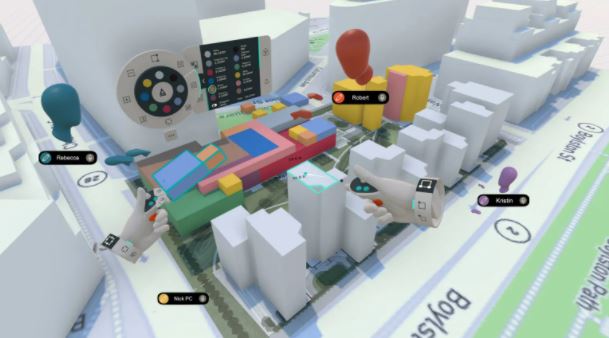
Students and teachers will regularly wander around proposed buildings at full scale. They’ll all be looking up and out of these creations, not down and into their little physical models.
It takes students years to learn the subtle difference between 1/4” and 1/8” scale drawings. It takes even longer to efficiently interpret the arcane drawing conventions of orthography and projection.
Sure: in my classrooms, today, the desks are still messy. Students rightfully make physical models -- to learn that gravity is an unforgiving collaborator. Students will always buy physical model materials -- to learn that connections are the soul of creative expression.
The difference is that driving the fun of building a physical model will be the recent memory of walking around a virtual one.
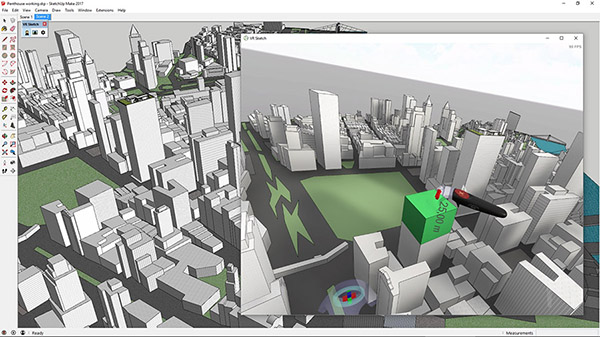
In 2018, Prof. Nolan and I established a functioning protocol for exporting students’ digital models from standard platforms like 3D Studio Max, Rhino or Revit, through the Unity Gaming Engine, and then through XCode to be installed on iOS devices and experienced in Google Cardboard headsets. We had to become iOS App developers in the process. It was all very exciting.
Today’s web-based VR tools have gotten a lot easier to use. In the studios where I teach, we’re not looking back.
This improved studio will see each student bring their own Virtual Reality (VR) glasses, in the same way that today, they bring laptops. Their homework will instruct the Virtual Design and Construction (VDC) techniques to explore their spatial and material ideas.
Students and teachers will regularly wander around proposed buildings at full scale. They’ll all be looking up and out of these creations, not down and into their little physical models.
It takes students years to learn the subtle difference between 1/4” and 1/8” scale drawings. It takes even longer to efficiently interpret the arcane drawing conventions of orthography and projection.
Sure: in my classrooms, today, the desks are still messy. Students rightfully make physical models -- to learn that gravity is an unforgiving collaborator. Students will always buy physical model materials -- to learn that connections are the soul of creative expression.
The difference is that driving the fun of building a physical model will be the recent memory of walking around a virtual one.
In 2018, Prof. Nolan and I established a functioning protocol for exporting students’ digital models from standard platforms like 3D Studio Max, Rhino or Revit, through the Unity Gaming Engine, and then through XCode to be installed on iOS devices and experienced in Google Cardboard headsets. We had to become iOS App developers in the process. It was all very exciting.
Today’s web-based VR tools have gotten a lot easier to use. In the studios where I teach, we’re not looking back.